
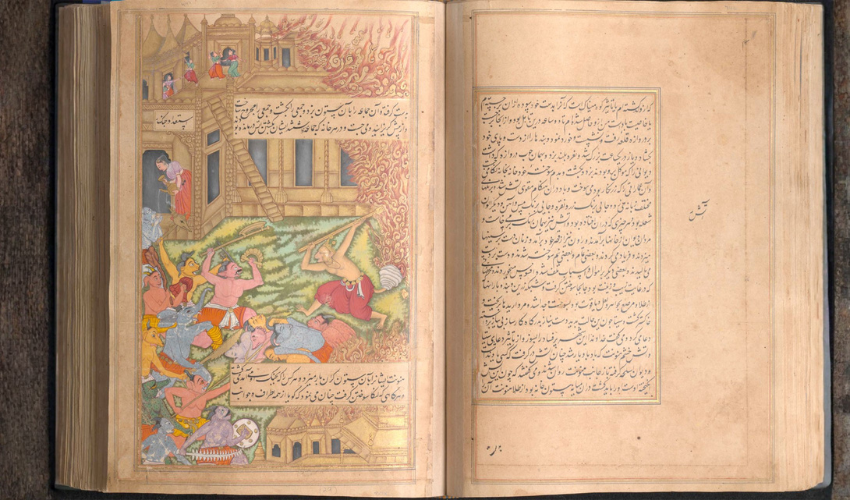
In the long history of South Asian letters, translation has rarely been a neutral act. When Akbar’s court undertook the rendering of Valmiki’s Ramayana into Persian in the late 1580s, it was participating in one of the most ambitious literary projects of the early modern era. It brought together Sanskrit-literate brahmans and Persian-speaking Mughal elites at Lahore to carry one of humanity’s oldest stories across the divide of two distinct languages and worlds. While there are any number of fascinating facets of this exercise, Audrey Truschke’s essay on the Doha Ramayana—the second oldest surviving copy of the Akbari translation and the oldest available to researchers, focusses on the method of translation itself.
Hindi acted as a bridge language: pandits read Valmiki aloud and rendered it into spoken Hindi, which the Mughals then shaped into written Persian prose. This oral transmission left vernacular traces, such as Rāma becoming Rām and Daśaratha becoming Jasrat. Yet, the translation maintained remarkable fidelity, retaining hundreds of Sanskrit words and preserving the epic’s phrasing. Simultaneously, the Mughals actively acculturated the epic for Persianate readers. They framed fantastical elements within the Islamic and Persian tradition of marvels (‘aja’ib), conceptualized magical weapons as spells (afsuns), and embedded verses from classical Persian poets like Sa’di and Daqiqi. They also added a “light Islamic flavour” by incorporating short Islamic prayers, equating ancient Indian kings like Manu to Adam (Abul Bashar), and frequently invoking the Islamic God (khuda) alongside Hindu deities.
The Doha manuscript does not explicitly name its patron, but records show its first owner was Hamida Banu Begum, Akbar’s mother, a vital detail placing it not at the periphery but at the intimate centre of Mughal power. The translation project was ultimately a political act, formulating imperial identity by absorbing Hindustan’s literary heritage into the Mughal imagination.
This tradition outlived Akbar. Over the next few hundred years, Persian-medium authors wrote around two dozen distinct Ramayanas, many dedicated to Mughal kings through the reign of ‘Alamgir (r. 1658–1707). Truschke’s essay places the Doha manuscript at the origin of this tradition, which successfully carried Valmiki’s epic into the Indo-Persian literary imagination.
Akbar’s court translated the Ramayana — one of two major Sanskrit epics — into Persian as part of one of the most extensive translation movements of the early modern era. Akbar began sponsoring Persian renderings of Sanskrit stories in the 1570s, starting with the Simhasana- dvatrimshika (‘Thirty-Two Tales of the Throne’). Attention soon turned to the Sanskrit epic Mahabharata, translated into Persian in the early to mid 1580s and renamed Razmnama (‘Book of War’). Akbar next ordered Valmiki’s Ramayana to be translated into Persian, a project that was completed in the late 1580s at the imperial court in Lahore.1 The next 15 years saw the production of a slew of Persian translations and adaptations of Sanskrit works, including Panchatantra (‘Five Tales’), Lilavati, Rajatarangini (‘River of Kings’) and Nal-Daman.2
As I argued elsewhere, the Mughals formulated aspects of their imperial identity as rulers of Hindustan through the process of translating texts, especially the two epics Ramayana and Mahabharata, written in ancient India’s premier literary language.3 Though not widely known or studied to date, the Doha manuscript is the second oldest copy of the Akbari Ramayana known to survive today and the oldest available to scholars. It reveals much about how and why the Mughals translated premodern India’s most beloved story into Persian.
Two teams of translators — Sanskrit-literate brahmans and Persian-speaking Mughal elites — collaborated at Akbar’s court to render the Sanskrit Ramayana into Persian. Hindi was the common language of the two groups. As described in the colophon of the Razmnama and a flyleaf note in the Freer Ramayana, brahman pandits read the Sanskrit text and verbally translated it into Hindi for the Mughals who then translated the spoken Hindi into a written Persian text.4 An illustration from the Razmnama further indicates how the two groups collaborated to produce the translation (fig. 1). In this image, both groups consult written texts, with some of the manuscripts near the brahmans appearing to be unbound horizontal manuscripts, consistent with early modern Sanskrit manuscripts from North India. The Ramayana textual translation drew upon key court talent, including Naqib Khan (a court historian), Sultan Thanisari (a financial administrator) and Bada‘uni (Akbar’s most prolific translator). 5 The name of only a single brahman engaged in the project is known, from among the presumably several who assisted with the translation: Deva Mishra, who also worked on the Razmnama. 6
The Mughal and brahman teams generated a relatively close Persian rendering of Valmiki’s Sanskrit Ramayana that bears markers of its verbal transmission. The Persian translation produces all seven books of Valmiki’s Ramayana along with various side stories and details. The translation begins with the numerous introductions within Valmiki’s text, including an overview of the story, the saga of the creation of poetry (kāvya) and a table of contents.7 Throughout, the Persian text retains hundreds, perhaps thousands, of Sanskrit words and names that constantly remind the reader that this is a Sanskrit tale with roots outside of the Persian and Islamic traditions. Many of the transliterated words reflect the verbal vernacular pronunciation that was part of the translation process. For instance, following the vernacular tendency to drop the final -a, Rāma in Sanskrit becomes Rām in Persian, while Daśaratha in Sanskrit (Rama’s father) becomes Jasrat in the Persian translation.8
The Akbari Ramayana further preserves traces of conversations that must have taken place between the brahman and Mughal translators with creative interpretations on the part of both. One example is the rendering of the sage Agastya’s name in Book 1. Agastya’s name refers to the star Canopus, and the Persian translation accordingly names the sage as Suhayl, the Persian word for Canopus.9 The Persian text also supplies the name of Agastya’s brother, Sutījan (Sutīksna in Sanskrit), which is not given in the corresponding Sanskrit verse but was presumably filled in by the brahman pandits.10 The Persian translation even occasionally repeats errors made by the brahman pandits in their interpretation of Valmiki’s Ramayana. For instance, during the war with Lanka, the Sanskrit text names Kubera using an epithet that the brahman translators mistook to refer to Shiva, and so Shiva (Persian mahādīv for Sanskrit mahādeva) is named in the corresponding section of the Persian translation.11
The text of the Akbari Ramayana preserves crucial evidence for the Sanskrit source of the translation, previously not identified. Valmiki’s Ramayana exists in numerous Sanskrit versions generally defined by script and region (e.g., Telugu, Grantha, Northeastern, etc.). The versions differ from one another in their inclusion of specific episodes, ordering of some stories, narrative location of breaks between the seven books and even wording in specific verses. If we can determine the Sanskrit version used to produce the Persian text, then we can read the Persian translation against the Sanskrit original. A crucial point here is that the Persian translation is relatively close to the Sanskrit source in many regards. Akbar’s court records are not explicit about which Sanskrit version served as the source, but the Persian translation offers many clues. Especially indicative is where the translation divides the seven books, which suggests that the Akbari Ramayana was based on a Devanagari version of Valmiki’s Sanskrit Ramayana (so-called because manuscripts of this version were typically written in the Devanagari script).12
The fact that the translation is quite close to the source Sanskrit text indicates that the Mughals valued precision and accuracy in their attempt to produce a Persian Ramayana. In many cases, the translators even maintained the Sanskrit epic’s turns of phrase. For instance, they follow the Sanskrit text in describing the demon Taraka (Tataka in Sanskrit), whom Rama fights as a young man, as possessing the strength of 1000 elephants.13 When Rama kills Ravana, the translation follows the Sanskrit text in mentioning that the gods sounded a war drum, sent a fragrant breeze and rained down flowers from the sky.14 The details retained in the translated text are not always represented in the illustrations. For instance, in the illustration of Rama slaying Ravana in the Doha Ramayana, sky-borne flowers appear but the gods are absent.15 Nonetheless, the translation and illustrations often correlate on specific details in the Doha Ramayana, which suggests a dynamic relationship between text and image. Links between text and image are a promising area of scholarship and have been explored recently in different ways by those looking at Indian and Persian materials.16
The Persian translation also retains the Sanskrit text’s emphasis on lists, which suggests that the epic’s inclination towards cataloguing was important to explore in Persian. A typical example is the listing of the monkey chiefs who assisted in building a bridge from the tip of India to Lanka. The Akbari Ramayana transliterates their names with diacritic marks to indicate their correct pronunciation in a Perso-Arabic script that does not routinely indicate short vowels (fig. 2).17 Even brief lists were reproduced in the Akbari translation, such as the five animals that brahmans and kshatriyas can eat.18 Where the translation is sometimes less precise is in details less immediately relevant to Persianate readers, such as information on the caste system and some poetic descriptions. But, in general, the translation is remarkably accurate. The Ramayana tale is about Indian kingship, a chief concern to the Mughals. Accordingly, early manuscripts of Akbar’s Persian Ramayana were linked to key imperial figures. The Doha manuscript does not name its patron, but it was first owned by Hamida Banu Begum, Akbar’s mother. Two inscriptions on the flyleaf, both dating after Hamida’s death, note that the manuscript was part of her library.19 A third note, written by Akbar’s son Jahangir (r. 1605–27), indicates that the manuscript passed into his royal collection in 1605.20 Jahangir also penned a note on the flyleaf of the Jaipur Ramayana — the master imperial copy of the translation — and so seemed to mark Rama’s story as occupying a prominent place in the royal imagination.21 The third oldest surviving copy of the translation was made in approximately 1600 for ‘Abd al-Rahim, an important noble, and is currently held at the Freer Gallery of Art in Washington, D.C.22
The Doha manuscript of the Akbari Ramayana makes references to its source text, Valmiki’s Ramayana, and retains some of its Sanskrit resonances. It uses diacritics regularly, especially upon the initial introduction of a Sanskrit word. As noted above, the translation tends toward vernacular pronunciations of Sanskrit terms, but the Mughal translators occasionally show concern for correct Sanskrit pronunciation. For instance, they wrote early in the text that Rama’s home city of Ajūdhā, a Persian transliteration of the Sanskrit Ayodhyā, is now known as Oudh, thus distinguishing Sanskrit from vernacular pronunciations.23 The translation frequently refers to Sanskrit as a language, introducing certain words ‘in Sanskrit’ or ‘in the Sanskrit language’ (bih hindī, bih zabān-i hindī ).24 The Sanskrit Ramayana references itself numerous times in the course of the epic. The Akbari rendering retains these mentions, which change meaning in translation to refer back to the source Sanskrit text. For instance, the translation records the number of Sanskrit shlokas in each of the seven books, which was self-referential in Valmiki’s Ramayana but transforms in the Persian translation into a description of the source text.25 Several times, the Akbari Ramayana mentions that Valmiki versified the story, a point that contrasts to the reader’s experience of absorbing the translation’s Persian prose.26 Valmiki’s Ramayana also places itself in a larger universe of Sanskrit texts, which the Persian translation preserves with references to Indian Sanskrit books (kutūb-i hindūān), such as the Vedas (bīd in Persian, ancient Hindu scriptures), the six auxiliary Vedic sciences (anga in Sanskrit; ank in Persian) and sūtra works (sūtar in Persian).27
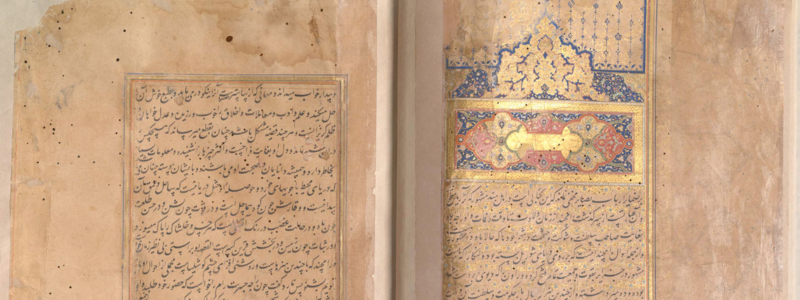
Many images in the Doha Ramayana depict Sanskrit manuscripts, which complement and enhance the Persian translation’s invocation of Sanskrit texts. The Jaipur Ramayana, too, furnishes visual depictions of Sanskrit works, such as two horizontal manuscripts around the sage Vishvamitra in one illustration and two depictions of the Hindu god Brahma holding a manuscript.28 The Doha manuscript builds upon this trend, and certain illustrations seem to almost overflow with texts. For instance, a depiction of a divine messenger at Dasharatha’s court in Book 1 includes three open manuscripts, one closed manuscript and one scroll (cat. 7). The text on the open manuscripts is illegible, but one manuscript has parts written in red and marginal notes, which is an accurate representation of Sanskrit and Indo-Persian manuscripts in the late 16th century. In contrast, the same scene in the Jaipur Ramayana depicts one, possibly two manuscripts, with few details.29 Another illustration in the Doha Ramayana detailing preparations for King Dasharatha’s sacrifice to obtain sons features six open manuscripts, seven closed manuscripts and two scrolls (cat. 6).30 An illustration of King Sagara’s court is more modest, showing only three closed manuscripts and a single open manuscript (cat. 12). A scene of Janaka’s court appears to mix Persian and Sanskrit manuscripts (cat. 13), with the image depicting four manuscripts: two horizontal and unbound (and so likely Sanskrit) manuscripts and one with scribbling that appears closer to Persian than Sanskrit.31 The text on the prior page describes a gathering of erudite men who speak a variety of languages (zabān-hā-i mukhtalif ). There are many more visual depictions of manuscripts in the Doha Ramayana, which also include illustrations of sages, kings and even the demon king Ravana, who is renowned as learned.32
While celebrating its origins as a Sanskrit epic, the Doha Ramayana also adapts Rama’s story for Persianate Mughal readers by means of several strategies, such as invoking the realm of marvels (‘ajā’ib). Both the Islamic and Persian traditions had long exhibited a strong appetite for writing about strange aspects of the world, often associated with India. Jahangir attests that the Mughals understood the Ramayana as part of a larger body of ‘ajā’ib works in his flyleaf note on the Jaipur manuscript, where he describes the epic as containing ‘strange and incredible stories (‘ajīb ū gharīb) that are truly incomprehensible to the intellect (‘aql ).’33 This accords with Mughal interpretations of the Mahabharata as fantastical, almost unbelievable at times, and also makes sense of some basic features of the Ramayana story, such as the appearance of armies of sentient bears and monkeys.34 The illustrations within the Doha manuscript perhaps give a nod to this reading of the story in their penchant for grotesques in the rocks, a similarly strange and inexplicable visual feature.35 The text also offers multiple examples of the use of afsūns (spells), especially during the battle for Lanka where magical weapons were employed. Here the translators are both faithful to the Sanskrit text while also overlaying — textually and visually — an interpretive layer of Persian and Islamic marvels.36
The Doha Ramayana also contains at least one citation of Persian poetry, used to acculturate the Sanskrit story for readers steeped in the Persian literary tradition. In the Razmnama, the translated text features interspersed poetry quoted from the great masters of Persian literature. The Akbari Ramayana does not follow this practice.37 But an illustration within the Doha manuscript contains a few lines of poetry etched into the façade of a building constructed for a royal sacrifice (cat. 6):
ﺟﻬﺎﻧﺖ ﺑﮑﺎم و ﻓﻠﮏ ﯾﺎر ﺑﺎد
ﺟﻬﺎن آﻓﺮﯾﻨﺖ ﻧﮕﻬﺪار ﺑﺎد
ﺑﮑﺎﻣﯽ ﺗﻮ ﺑﺎد اﻧﻬﻤﻪ ﮐﺎر ﺗﻮ
ﺧﺪاوﻧﺪ ﺑﺎد ﻧﮕﻬﺪار ﺗﻮ
May the world be to your liking and the sky be a friend.
May the Creator be your guardian.
May all your actions go as you wish.
May God sustain you!
These lines are borrowed from the 13th-century poet Sa‘di and the 10th-century poet Daqiqi, respectively, and so proclaim a powerful link between the Akbari Ramayana and Persian literature. The same lines also appear in other Mughal imagery, such as in an illustration of Layla and Majnun, archetypal lovers in Persian literature, produced for a muraqqa‘ (album) of Jahangir.38 Such links add a further layer of resonance with the Persian literary tradition claimed by the Mughals.
The Akbari Ramayana provides a light Islamic flavour to parts of the epic. Short Islamic prayers are inserted at the end of some chapters in the Doha manuscript, some of which are lacking in the Freer copy.39 The translation identifies Raja Manu, an ancient Indian king, as Abul Bashar (Adam), an equivalence that places the Ramayana within an accepted Islamic historical framework.40 Later the text mentions ab-i hayat (water of life), usually associated with Khizr in Islamic thought.41 The Islamic God — often called khudā or khudāvand — appears throughout the text, frequently alongside various Hindu gods in the same manner seen in the Persian Mahabharata. 42 For instance, in Book 1, Rama lifts Shiva’s bow at Janaka’s court in the name of Khuda.43 In Book 4, Maya, a demon and accomplished architect, worships God (haqq) for thousands of years and then Brahma appears (in Sanskrit, Brahma appears after Maya performs religious austerities, tapas, for thousands of years).44 Most of these changes are probably original to the Akbari translation, although one cannot be sure without access to the Jaipur manuscript.
In at least one place, the Doha Ramayana includes additional Islamic elements beyond the original translated text. In the story of the creation of poetry, the Doha manuscript removes a mention of Valmiki bathing in the name of the Hindu gods (present in both the Jaipur and Freer copies) and adds a curse in the name of khudā (the Jaipur and Freer copies do not mention Khuda here).45 Perhaps these light changes were meant to accommodate Muslim readers of this manuscript by providing them with a more familiar world featuring a single, all-powerful deity.46 Still, despite the overlay of an Islamic God, the Hindu gods still provide a core framework for the Akbari Ramayana, especially in Book 7 where some of Vishnu’s feats are recounted at great length.
After the Akbari translation of Valmiki’s epic, the Ramayana story exploded in Persian. Over the next few hundred years, Persian-medium authors penned around two dozen distinct Persian Ramayanas.47 Many were dedicated to the Mughal kings through ‘Alamgir (r. 1658–1707), which indicates an ongoing perceived link on the part of literati between Mughal royalty and the Ramayana. Later authors also retold the Ramayana in Urdu.48 Post-Akbar Persian adaptations were not always based on Sanskrit versions of the epic, and some included popular late innovations such as Lakshmana’s rekha (a line to keep Sita safe) and a regional story in which Sita is tricked into drawing a picture of Ravana on a piece of paper.49
Many Persian-medium authors chose to retell the Ramayana saga in Persian poetry, rather than the Mughal translators’ choice of prose. Within this vast ocean of Persian Ramayanas, the Akbari translation stands at the forefront as the rendering that first introduced the full story of this vibrant epic to the Indo-Persian literary imagination.
1. See Marika Sardar’s introductory essay in this volume on the date of the initial production of the Akbari Persian Ramayana. Akbar moved his court to Lahore in 1585.
2. These works are, respectively, a storybook, a poetic mathematical treatise, a history of Kashmir and the tale of lovers Nala and Damayanti. For overviews of translations in Akbar’s court, see, e.g., Ali, Translations of Sanskrit Works at Akbar’s Court; Haider, Translating Texts and Straddling Worlds’; Truschke, Culture of Encounters, pp. 101-102.
3. Truschke, Culture of Encounters, ch. 3 and Truschke, ‘The Mughal Book of War’]
4. For the Razmnama colophon, see Truschke, Culture of Encounters, p. 104 (English translation) and British Library, Persian Add. 5642, f. 481b (Persian). For the Ramayana flyleaf note, see Truschke, Culture of Encounters, p. 212 (English translation); Seyller, Workshop and Patron, pp. 73-74 (English translation and Persian); Freer Ramayana, f. 1a (Persian, printed in Seyller, Workshop and Patron, p. 73).
5. Abu’l Fazl lists all three Persian-medium translators (Ain-i Akbari, vol. 1, p. 115); “Abd al-Rahim names only Nagib Khan (flyleaf in Seyller, Workshop and Patron, pp. 73-74). Bada’uni mentions only himself as translator in what may or may not be the same translation; some ambiguity arises due to Bada’uni’s remarks on having composed a verse translation of the Ramayana (for more, see Truschke, Culture of Encounters, p. 306, note 6). Later sources occasionally attribute the Akbari Ramayana, incorrectly, to Abu’l Fazl, a historian and Akbar’s chief ideologue (e.g., Bibliothèque natonale de France, Supplément Persan 17).
6. ‘Abd al-Rahim names Deva Mishra as a Sanskrit- medium translator (flyleaf in Seyller, Workshop and Patron, pp. 73-74). For Deva Mishra’s involvement in producing the Persian Mahabharata, see Truschke, Culture of Encounters, p. 104.
7. The table of contents is Appendix 1 (anukramanika) in Valmiki Ramayana, vol. 1, pp. 401-410, corresponding to Doha Ramayana, pp. 17-28. All references to the Sanskrit Ramayana refer to the critical edition (Valmiki Ramayana) and specifically to the Devanagari version variants.
8. The Akbari Ramayana often gives Rama’s name as Râmchand, a Persian transiteration of Sanskrit Rámacandra, a common name for Rama.
9. Agastya is also named as Suhavl in the Razmnama (Truschke, “Mughal Book of War”, p. 511).
10. Doha Ramayana, p. 5, lines 16-17; Valmiki Ramayana 1,1.33.
11. This episode ocurs at the end of Book 5 in the Akbari Ramayana, typically given at the beginning of Book 6 in the Sanskrit critical edition of Ramayana (p. 464, cat. 33). The epithet in question is bhüteśa (Valmiki Ramavana 6.4.16). Mention of the elephant Sarvabhauma makes it clear that the referent is Kubera, but the epithet is more commonly used for Shiva (see Yuddhakanda, trans. Goldman, Goldman and van Nooten, p. 522, note on 6.4.16).
12. Some markers in the Akbari Ramayana hinting that its source text was a Devanagari-version Ramayana are as follows. Valmiki Ramayana 2.108-111 is included as the beginning of Book 3 (Valmiki Ramayana, p. 611, note at beginning of 2.108); this is indicated in Doha Ramavana, p. 264 with a gap where a red heading that marks the beginning of chapter 3 should have been written. Hanuman’s leap is included at the end of Book 4 instead of opening Book 5, which suggests a northern recension, perhaps northwest specifically (Jhala, introduction to critical edition of Valmiki Ramayana, 5:xxx). Several opening Book 6 are included at the end chapters of of Book 5. Book 7 of the Doha Ramayana ends with a list of topics (pp. 927-928) that is similar to manuscript D12 of the Sanskrit critical edition (Valmiki Ramayana, vol. 7, pp. 543-544). While I am fairly certain about this determination, it remains somewhat tentative without access to the Jaipur manuscript of the Akbari Ramayana. The Razmnama is based on a Devanagari version of the Sanskrit Mahabharata (Truschke, “Mughal Book of War”, p. 509).
13. Valmiki Ramayana 1.23.24 (balam någasahasrasya dharayanti); Doha Ramayana, Museum Rietberg RVI 1840, cat. 9 (quwwat-i hazăr fil dãrad).
14. Doha Ramayana, p. 702; Valmiki Ramayana 6.97.26-27.
15. Doha Ramayana, p. 701.
16. For example, Adamjee and Truschke, ‘Reimagining the “Idol Temple of Hindustan””*; Rice, ‘Brush and the Burin’; Farhad, ‘Reading Between the Lines’.
17. Doha Ramayana, p. 484a; Valmiki Ramayana, 6.15.283*, line 5; the Doha Ramayana gives Gandhamadana as the variant Sugandhamädana.
18. This is given within Vali’s reproach of Rama. Doha Ramayana, pp. 345-346; Valmiki Ramayana, 4.17.34.
19. In both cases, Hamida Banu Begum is referred to by her post-death name, Maryam-Makani (Doha Ramayana, p. 1, cat. 1; Seyller, “The Inspection and Valuation of Manuscripts’, p. 304).
20. Doha Ramayana, p. 1; Seyller, ‘The Inspection and Valuation of Manuscripts’, p. 304.
21. The Jaipur Ramayana has been inaccessible to scholars for decades. Some illustrated pages from the Jaipur Ramayana have been printed in Das, “An Introductory Note on the Emperor Akbar’s Ramayana and Its Miniatures*; Das, ‘Akbar’s Imperial Ramayana’; Seyller, Workshop and Patron; Okada, ed., Ramayana de Valmiki illustré.
22. On this manuscript, see Seyller, Workshop and Patron.
23. Doha Ramayana, p. 2, line 3.
24. Hindi was the common Persian word for both Sanskrit and vernacular Hindi at the time, but within the Akbari Ramayana it usually means Sanskrit. We also see mentions of Sanskrit in the Jaipur manuscript (e.g., cat. 46, line 2).
25. For example, Doha Ramayana, pp. 17-25.
26. For example, Doha Ramayana, pp. 30, 905 and 927.
27. For example, Doha Ramayana, p. 52a; also see Freer Ramayana, f. 24b (kutüb-i hindůãn, sütra). Doha Ramayana, p. 906 (bid, ank), following Valmiki Ramayana 7.13.16.
28. Jaipur Ramayana, painting no. 31 (Vishvamitra) and painting nos. 33 and 176 (Brahma). Brahma is also depicted holding a manuscript in the “Burnt Ramayana’ (Okada, ed., Ramayana de Valmiki illustré, 6:289).
29. Jaipur Ramayana, painting no. 6
30. Doha Ramayana, p. 53.
31. Doha Ramayana, p. 117.
32. For example, Doha Ramayana, pp. 147 (sage), 162 (sage), 171-177 (Ravana), 773 (Ravana) and 892 (king).
33. Jaipur Ramayana, flyleaf note. Translated in Truschke, Culture of Encounters, p. 210.
34. Truschke, Culture of Encounters, pp. 109-110.
35. Earlier Persian artists had also used grotesques in rocks, such as Sultan Muhammad in his c. 1535 illustration of Shahnama (e.g., Death of Zahhak, Aga Khan Museum AKM155).
36. For example, Doha Ramayana, p. 585 on Rama using tir-há-yi afsün-åmiz-i hül-nåk to slay Kumbhakarna and p. 701 on using afsůn-i brahmã to kill Ravana.
37. So far, I have identified a single half line of poetry (Doha Ramayana, p. 88 and Freer Ramayana, f. 39a).
38. Koch, ‘Mughal Emperor as Solomon’, pp. 281 and 289-291.
39. For example, Doha Ramayana, pp. 16, 30, 159, 335, 404, 491a, 928 (not at the end of Book 2 on p. 264 nor at the end of Book 6 on p. 745). Without access to the Jaipur Ramayana, I cannot tell if these are added in the Doha copy, deleted in the Freer copy or some combination of those two possibilities.
40. Doha Ramayana, p. 30.
41. Doha Ramayana, p. 70.
42. Truschke, ‘Mughal Book of War”, pp. 512-516.
43. Doha Ramayana, p. 147 (p. 145 talks about it being Shiva’s bow); also see Freer Ramayana, f. 63.
44. Doha Ramayana, pp. 378-379; Valmiki Ramayana 4.50.12
45. Doha Ramayana, pp. 13-14; Jaipur Ramayana, pinting no. 1; Freer Ramayana, f. Ga.|
46. Truschke, Culture of Encounters. p. 116.
47. For a list, see Mujtabai, Aspects of Hindu Muslim Cultural Relations, pp. 68-71.
48. Phillips, ‘Urdu Ramayans’.
49. For example, National Museum, New Delhi 59.268, painting nos. 6-7 and painting no. 144, respectively.
Audrey Truschke is a Professor of South Asian History at Rutgers University–Newark. She has written four widely praised books: Culture of Encounters: Sanskrit at the Mughal Court (2016), Aurangzeb (2016), The Language of History: Sanskrit Narratives of Indo-Muslim Rule (2021), and India: 5,000 Years of History on the Subcontinent (June 2025).
| 2500 BC - Present | |
|
2500 BC - Present |
| Tribal History: Looking for the Origins of the Kodavas | |
| 2200 BC to 600 AD | |
|
2200 BC to 600 AD |
| War, Political Violence and Rebellion in Ancient India | |
| 400 BC to 1001 AD | |
|
400 BC to 1001 AD |
| The Dissent of the ‘Nastika’ in Early India | |
| 600CE-1200CE | |
|
600CE-1200CE |
| The Other Side of the Vindhyas: An Alternative History of Power | |
| c. 700 - 1400 AD | |
|
c. 700 - 1400 AD |
| A Historian Recommends: Representing the ‘Other’ in Indian History | |
| c. 800 - 900 CE | |
|
c. 800 - 900 CE |
| ‘Drape me in his scent’: Female Sexuality and Devotion in Andal, the Goddess | |
| 1100–1199 CE | |
|
1100–1199 CE |
| Topography as History: Reading Kashmir through Rajatarangini | |
| 1192 | |
|
1192 |
| Sufi Silsilahs: The Mystic Orders in India | |
| 1200 - 1850 | |
|
1200 - 1850 |
| Temples, deities, and the law. | |
| c. 1500 - 1600 AD | |
|
c. 1500 - 1600 AD |
| A Historian Recommends: Religion in Mughal India | |
| 1200-2020 | |
|
1200-2020 |
| Policing Untouchables and Producing Tamasha in Maharashtra | |
| 1530-1858 | |
|
1530-1858 |
| Rajputs, Mughals and the Handguns of Hindustan | |
| 1575 | |
|
1575 |
| Abdul Qadir Badauni & Abul Fazl: Two Mughal Intellectuals in King Akbar‘s Court | |
| 1579 | |
|
1579 |
| Padshah-i Islam | |
| 1594 | |
|
1594 |
| Translating Rama: The Making and Meaning of Akbar’s Persian Ramayana | |
| 1550-1800 | |
|
1550-1800 |
| Who are the Bengal Muslims? : Conversion and Islamisation in Bengal | |
| c. 1600 CE-1900 CE | |
|
c. 1600 CE-1900 CE |
| The Birth of a Community: UP’s Ghazi Miyan and Narratives of ‘Conquest’ | |
| 1553 - 1900 | |
|
1553 - 1900 |
| What Happened to ‘Hindustan’? | |
| 1630-1680 | |
|
1630-1680 |
| Shivaji: Hindutva Icon or Secular Nationalist? | |
| 1630 -1680 | |
|
1630 -1680 |
| Shivaji: His Legacy & His Times | |
| c. 1724 – 1857 A.D. | |
|
c. 1724 – 1857 A.D. |
| Bahu Begum and the Gendered Struggle for Power | |
| 1818 - Present | |
|
1818 - Present |
| The Contesting Memories of Bhima-Koregaon | |
| 1828-1843 | |

|
1828-1843 |
| Scandal of Manners: ‘Urinating Standing Up’ | |
| 1831 | |
|
1831 |
| The Derozians’ India | |
| 1855 | |
|
1855 |
| Ayodhya 1855 | |
| 1856 | |
|
1856 |
| “Worshipping the dead is not an auspicious thing” — Ghalib | |
| 1857 | |
|
1857 |
| A Subaltern speaks: Dalit women’s counter-history of 1857 | |
| 1858 - 1976 | |
|
1858 - 1976 |
| Lifestyle as Resistance: The Curious Case of the Courtesans of Lucknow | |
| 1883 - 1894 | |
|
1883 - 1894 |
| The Sea Voyage Question: A Nineteenth century Debate | |
| 1887 | |
|
1887 |
| The Great Debaters: Tilak Vs. Agarkar | |
| 1893-1946 | |
|
1893-1946 |
| A Historian Recommends: Gandhi Vs. Caste | |
| 1897 | |
|
1897 |
| Queen Empress vs. Bal Gangadhar Tilak: An Autopsy | |
| 1910-1950 | |
|
1910-1950 |
| Forging Unity: Vallabhbhai Patel and the Politics of Nationalism | |
| 1913 - 1916 Modern Review | |
|
1913 - 1916 |
| A Young Ambedkar in New York | |
| 1916 | |
|
1916 |
| A Rare Account of World War I by an Indian Soldier | |
| 1917 | |
|
1917 |
| On Nationalism, by Tagore | |
| 1918 - 1919 | |
|
1918 - 1919 |
| What Happened to the Virus That Caused the World’s Deadliest Pandemic? | |
| 1920 - 1947 | |
|
1920 - 1947 |
| How One Should Celebrate Diwali, According to Gandhi | |
| 1921 | |
|
1921 |
| Great Debates: Tagore Vs. Gandhi (1921) | |
| 1921 - 2015 | |
|
1921 - 2015 |
| A History of Caste Politics and Elections in Bihar | |
| 1915-1921 | |
|
1915-1921 |
| The Satirical Genius of Gaganendranath Tagore | |
| 1924-1937 | |
|
1924-1937 |
| What were Gandhi’s Views on Religious Conversion? | |
| 1900-1950 | |
|
1900-1950 |
| Gazing at the Woman’s Body: Historicising Patriarchal Lechery | |
| 1925, 1926 | |
|
1925, 1926 |
| Great Debates: Tagore vs Gandhi (1925-1926) | |
| 1928 | |
|
1928 |
| Bhagat Singh’s dilemma: Nehru or Bose? | |
| 1930 Modern Review | |
|
1930 |
| The Modern Review Special: On the Nature of Reality | |
| 1932 | |
|
1932 |
| Caste, Gandhi and the Man Beside Gandhi | |
| 1933 - 1991 | |
|
1933 - 1991 |
| Raghubir Sinh: The Prince Who Would Be Historian | |
| 1935 | |
|
1935 |
| A Historian Recommends: SA Khan’s Timeless Presidential Address | |
| 1865-1928 | |
|
1865-1928 |
| Understanding Lajpat Rai’s Hindu Politics and Secularism | |
| 1935 Modern Review | |
|
1935 |
| The Modern Review Special: The Mind of a Judge | |
| 1936 Modern Review | |
|
1936 |
| The Modern Review Special: When Netaji Subhas Bose Was Wrongfully Detained for ‘Terrorism’ | |
| 1936 | |

|
1936 |
| Annihilation of Caste: Part 1 | |
| 1936 Modern Review | |
|
1936 |
| The Modern Review Special: An Indian MP in the British Parliament | |
| 1936 | |
|
1936 |
| Annihilation of Caste: Part 2 | |
| 1936 | |
|
1936 |
| A Reflection of His Age: Munshi Premchand on the True Purpose of Literature | |
| 1936 Modern Review | |
|
1936 |
| The Modern Review Special: The Defeat of a Dalit Candidate in a 1936 Municipal Election | |
| 1937 Modern Review | |
|
1937 |
| The Modern Review Special: Rashtrapati | |
| 1938 | |
|
1938 |
| Great Debates: Nehru Vs. Jinnah (1938) | |
| 1942 Modern Review | |
|
1942 |
| IHC Uncovers: A Parallel Government In British India (Part 1) | |
| 1943-1945 | |
|
1943-1945 |
| Origin Of The Azad Hind Fauj | |
| 1942-1945 | |
|
1942-1945 |
| IHC Uncovers: A Parallel Government in British India (Part 2) | |
| 1946 | |
|
1946 |
| Our Last War of Independence: The Royal Indian Navy Mutiny of 1946 | |
| 1946 | |
|
1946 |
| An Artist’s Account of the Tebhaga Movement in Pictures And Prose | |
| 1946 – 1947 | |
|
1946 – 1947 |
| “The Most Democratic People on Earth” : An Adivasi Voice in the Constituent Assembly | |
| 1946-1947 | |
|
1946-1947 |
| VP Menon and the Birth of Independent India | |
| 1916 - 1947 | |
|
1916 - 1947 |
| 8 @ 75: 8 Speeches Independent Indians Must Read | |
| 1947-1951 | |
|
1947-1951 |
| Ambedkar Cartoons: The Joke’s On Us | |
| 1948 | |
|
1948 |
| “My Father, Do Not Rest” | |
| 1940-1960 | |
|
1940-1960 |
| Integration Myth: A Silenced History of Hyderabad | |
| 1948 | |
|
1948 |
| The Assassination of a Mahatma, the Princely States and the ‘Hindu’ Nation | |
| 1949 | |
|
1949 |
| Ambedkar warns against India becoming a ‘Democracy in Form, Dictatorship in Fact’ | |
| 1950 | |
|
1950 |
| Illustrations from the constitution | |
| 1951 | |
|
1951 |
| How the First Amendment to the Indian Constitution Circumscribed Our Freedoms & How it was Passed | |
| 1950-1951 | |
|
1950-1951 |
| Panikkar’s 1950 Ordeal: China’s Moves, Family Crisis, and Diplomatic Distrust | |
| 1967 | |
|
1967 |
| Once Upon A Time In Naxalbari | |
| 1970 | |
|
1970 |
| R.C. Majumdar on Shortcomings in Indian Historiography | |
| 1973 - 1993 | |
|
1973 - 1993 |
| Balasaheb Deoras: Kingmaker of the Sangh | |
| 1975 | |
|
1975 |
| The Emergency Package: Shadow Power | |
| 1975 | |
|
1975 |
| The Emergency Package: The Prehistory of Turkman Gate – Population Control | |
| 1977 – 2011 | |
|
1977 – 2011 |
| Power is an Unforgiving Mistress: Lessons from the Decline of the Left in Bengal | |
| 1982 | |
|
1982 |
| The Abandoned Poet: Narayan Gangaram Surve and the Literature of the Mill | |
| 1984 | |
|
1984 |
| Mrs Gandhi’s Final Folly: Operation Blue Star | |
| 1916-2004 | |
|
1916-2004 |
| Amjad Ali Khan on M.S. Subbulakshmi: “A Glorious Chapter for Indian Classical Music” | |
| 2008 | |
|
2008 |
| Whose History Textbook Is It Anyway? | |
| 2006 - 2009 | |
|
2006 - 2009 |
| Singur-Nandigram-Lalgarh: Movements that Remade Mamata Banerjee | |
| 2020 | |
|
2020 |
| The Indo-China Conflict: 10 Books We Need To Read | |
| 2021 | |
|
2021 |
| Singing/Writing Liberation: Dalit Women’s Narratives | |
Leave a Reply