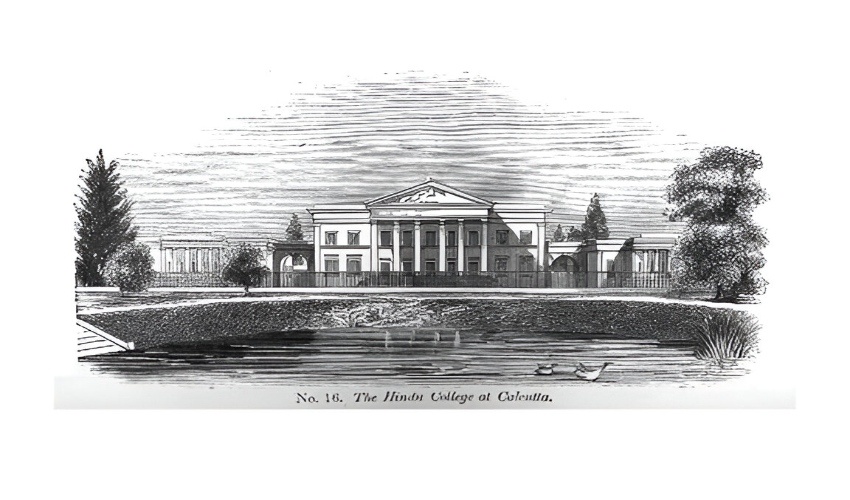
In the late 1820s, the Hindu College in Calcutta became an unlikely centre for intellectual upheaval. The catalyst was Henry Louis Vivian Derozio (1809–1831), a young Eurasian poet and teacher of history and English literature. His students, later known as Young Bengal, were encouraged to debate, argue, and subject every received truth to rational enquiry. They formed associations, published newspapers, staged plays, and brought ideas of liberty, equality and free expression into public life for the first time in India.
Young Bengal were not nationalists in the later sense, but they were among the first Indians to declare in print and speech that moral responsibility must rest on reason and conscience, not on custom or inherited authority. This made them targets of immense hostility. Their behaviour was denounced in newspapers, their families feared social excommunication, and their actions became the subject of rumour, satire and censure.
The chapter we publish here, “Scandal of Manners,” shows how everyday conduct became the ground of this conflict. What conservative society identified as lapses of etiquette—shoes instead of bare feet, uncovered heads, the refusal to wear a sacred thread, even “urinating standing up”, were seen as public renunciations of Hindu identity. Samāchār Chandrikā printed letters from distressed parents, one complaining that his son now dismissed advice as “nonsense” and called Brahmin pundits thieves. Sambad Prabhakar itemised the correct behaviour expected of Hindu students: shaved heads, ritual purity, tilak on the forehead, and reverence for caste rules. Satirical poems lampooned not only the young men of Hindu College but also women receiving Western education, caricaturing their manners and speech as marks of social decline.
Against this tide, Young Bengal defended themselves not as rebels without cause but as adherents of truth and moral independence. When his father urged him to perform traditional funeral rites for his grandfather, Ramgopal Ghose refused, declaring he could not carry out rituals he did not believe in merely to uphold caste respectability. Rasik Krishna Mullick declined to swear an oath in Sanskrit before the Supreme Court, explaining publicly that he did not know the language and would not feign belief. Saradaprasad Bose answered openly during Durga Puja that he did not regard the idol, though he promised to study the śāstras further before drawing final conclusions. These responses show how they sought to act from conviction, even when this meant estrangement from family or society.
Chaudhuri’s book reminds us that the decades between Rammohun Roy and Vidyasagar were not an empty interval but a period when a new generation attempted to define Indian modernity in their own terms. In Calcutta of the 1830s, questions of belief, dress, ritual and conduct were debated in newspapers, pamphlets, plays and associations. Young Bengal occupied the centre of this debate, forcing society to confront issues of authority, freedom of thought and the place of religion in civic life.
We have chosen this excerpt because it illustrates, with unusual clarity, the stakes of those disputes. What appeared as minor questions of manners were in fact disputes about legitimacy and control: who had the authority to dictate social conduct, and on what grounds. The voices gathered here—conservative critics, anxious parents, satirists, and the students themselves, make visible the ferment of an early radical moment in Indian history.
The scandal of manners and habits and Young Bengal’s flouting of urgent social and religious duties created general outrage, accompanied by serious alarm at their defiant and very public setting aside of societal norms and expectations. Reports of drugging, abduction, threat and coercion are documented against almost all members of Young Bengal, as families and parents became more and more despairing of losing their sons forever. Not yet out of their twenties, it was the public positions taken by these youths that was the greater part of the reason why Hindu society was as agitated and upset as it was in 1830–31. Expulsion from home, financial deprivation and rumour and scandal of gargantuan proportions followed perceived acts of youthful transgression, creating a social and political theatre of the middle classes such as had never been witnessed before (or indeed since). In response, Young Bengal grounded their activities on morality and ethical behaviour, holding up truth and reason as their ultimate goal, insisting time and again on holding fast to their principles in the face of a hostile orthodoxy and what was effectively a form of excommunication. In 1830, the conservative Samācār Candrikā carried a long letter from an irate correspondent who signed as ‘The Father of a Hindu College student’, complaining that his hitherto docile son, as a result of his education there, had not only abandoned his traditional manners and dress (ācār byābahār o poṣāk), but, when advised humility, had replied with the English word ‘nonsense’ (jātiya biṣay abhimāntyāgī upadeś kathā hailei nonsense kahe), called Brahmin pundits robbers and thieving cows (chor o dākāit goru), and strode around in [leather] shoes like the English (jakhan hāñte ingrejder mata mas mas koriyā druta cale). Meanwhile, the most popular Bengali paper with the widest circulation, Ishwar Gupta’s Saṃbād Prabhākar, was also agitated about the general godless un-Hindu appearance of the students of the Hindu College, complaining, in July 1831, that the managing committee of the college, which had just appointed Mr Speede as principal in place of Mr D’Anselme (who had been principal in the time of Derozio), should take care that the students of the Hindu college:
… should not be allowed to dress like firingis – such as the firingi habit of wearing shoes, growing their hair, not covering their head, wearing āngarākhās, going without a string around their necks, believing that creation, existence and destruction happen due to natural causes, urinating standing up, etc. Instead, they should shave their heads, not wear firingi shoes, wear upper-body coverings in the form of an uṛāni or eklāi, wear a string, not eat untouchable food, wear a tilak on their foreheads and a dhuti with three folds, always sing the praises of god, and urinate only after removing their underwear and using water afterwards – only then will the sons of Hindus look like Hindus, otherwise watching them roam around the city streets like the sons of firingis burns respectable and eminent people up with anger, therefore it would be best if the College members of the committee establish good rules rather than bad ones in the college.
Ishwar Gupta had expressed his outrage in the Prabhākar both in prose and in verse, writing specifically about Young Bengal and the new generation of modern Indians in his poems:
Nay ‘mag’ ‘firingi’, biṣam ‘dhingī’
Bhitar bāhir jāy nā jānā.
Gharer dheñki, kumīr haye,
Ghatāy kata aghatanā.
They’re neither the lawless Burmese nor
foreigners yet they’re terribly unruly
No one knows what’s going on with them – inside or out.
They were domestic fools before, now they are like crocodiles,
Constantly wreaking havoc.
The target of the poem’s following lines are the educated young women who have been ruined by ‘Bethune’—they snap their fingers at old rites and rituals and pick up books instead, learn the English alphabet, dress like bibis (European women), and talk in English too (jata chuñṛigulo tuṛi mere / ketāb hāte nice jabe/ takhan ‘A B’ śikhe, bibi seje, bilātī bol kabei kabe). As we know, however, Ishwar Gupta’s opinions underwent a change, conventionally dated from the time he joined the Tattvabodhinī Sabhā in 1839, so that the same paper then published an opinion piece titled ‘Śrībidyā’ (‘Women’s Education’) in 1849 congratulating Dakshinaranjan for having donated for a girls’ school, for which no words of praise could be enough (‘ataeb ihāte āmrā mukhopādhyāy babuke ki baliyā praśangsa kariba eman śabda prāpta hai nā’).
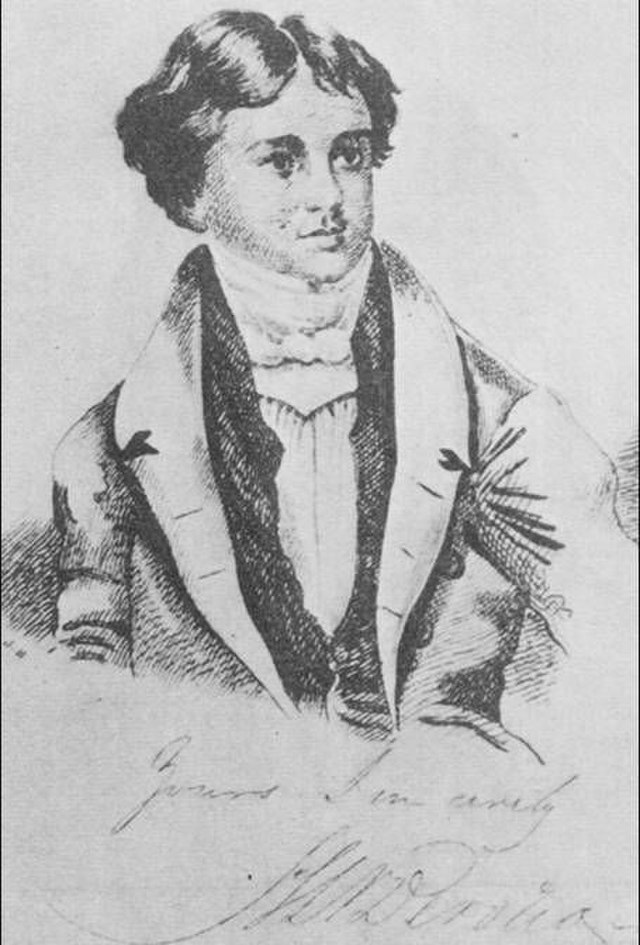
Figure: Henry Louis Vivian Derozio
These are just a few of the many complaints flooding in from correspondents and journalists in these years, and they were not confined to the Bengali-language papers alone. In the same year—1831—a correspondent in the Hurkaru calling himself ‘A Hindoo’ fulminated against a radical letter-writer: ‘will you ask your correspondent what are the immoral acts he has found in the moderate party? Have they thrown meat in the house of their neighbours? Have they treated their parents with contempt? Do they abuse them as the Ultras do? If these be the moral acts of the Ultras, the moderates are I should think happy in being free from them.’24 ‘And what is the object of this censure?’ asked an ‘Ultra’ in a reply four days later in the same paper: ‘Says he in one place, “but some of our youthful Hindoo Reformers, from a weak imitation of English customs are now in the practice of going about with their heads uncovered”.’ Our Ultra then quotes Derozio’s East Indian as having called this ‘but a trifling matter’, even though the ‘Editor of the India Gazette, however, with a grave face talks of it, as if it were a violation of the laws of religion and morality’. Both the moderates and the radicals, says Ultra, are ‘guilty of the horrible crime’ of not covering their heads and wearing western-style shoes, but ‘the Radicals are excusable, because they do not do so as a matter of singularity but of convenience’. The East Indian, responding to Hindoos’, for ‘the bigots [are] adopting strange measures to get rid of the Ultras’, advising them to ‘be mild’, ‘more temperated (sic) in their writings, and more charitable to their opponents’, ‘for a soft answer turneth away wrath’.
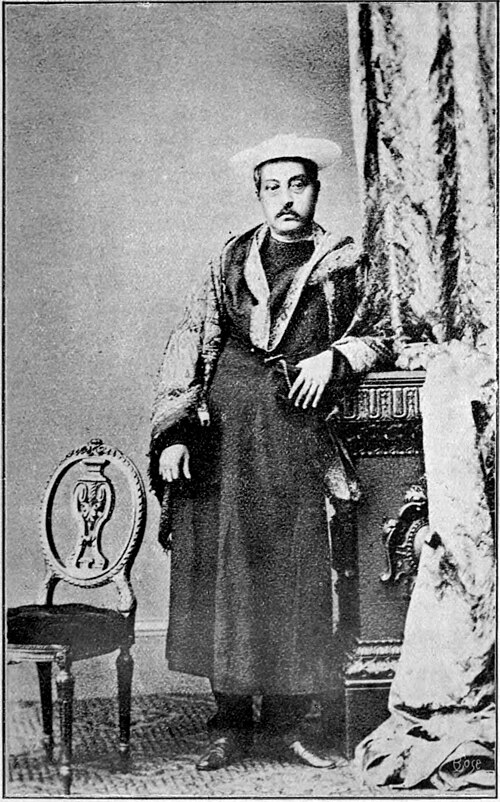
Figure: Ramgopal Ghosh
The public disavowal by Young Bengal of all Hindu rituals, customs and manners became a matter of grave seriousness when it affected, for instance, those ceremonies required to be performed after death, thus impacting one’s after-life. Ramgopal Ghose had refused his father just such a request regarding the performance of his grandfather’s funeral rites (śrāddha):
As an instance of his firmness and truthfulness we may mention that when his grand-father died, not one Brahmin would eat at his house on the occasion of the shrad. The dolopotees would however restore him to society if he would only confess that he had not taken forbidden food. His father with tears in his eyes asked Ramgopaul whether he would not save his caste by this simple confession. The son wept and said – ‘Father, I would do anything for you, even give up my life, but would not lie!’
Later in life, however, when the government proposed to ban the burning of dead bodies on the banks of the Hooghly, Ramgopal remained committed to his ideals but was more empathetic to the general feeling: ‘As for myself, Sir, I care not where my body may be burned after death, but I consider it my duty to stand up here, on behalf of the vast majority of my countrymen, who would feel it to be a dire calamity’. Meanwhile, putting the immediate events of his life into fictional form, Krishnamohan had depicted the orthodox Brahmin father in his play—The Persecuted, or Dramatic Scenes, Illustrative of the Present State of Hindoo Society, in Calcutta—pleading with his son not to eat forbidden food publicly, saying: ‘I care not for the most dissolute life you may lead, but do preserve our caste.’ In real life, the ultra-radical son, as we know from the much-recounted scandal of his friends having thrown beef into a Brahmin neighbour’s house that same year, had left home rather than apologize or repent. Life and theatre resembled each other closely in Krishnamohan’s play as he battled extreme vilification and condemnation as a result of his actions. He had hoped in the Enquirer that ‘this storm of persecution so violent upon us will ere long be succeeded by a pleasing calm’, reminding his readers of the fates of Galileo and Socrates, so that even ‘in the midst of our suffering’ he and his friends could ‘look out to our conscience for our satisfaction’.
Rammohun’s Saṃbād Kaumudī had noticed, when the Enquirer first appeared, that ‘the articles printed in the paper were all composed by Hindu youths and that these youths were not older than fourteen or fifteen’. It also remarked that it was a great pleasure (abaśyai āhlādita hailām) to see how well-educated these youths were (tāhāder etābath alpa bayese je erup bidyā janmiyāche ihāte biśeṣ anurāg karilām). Such generosity, however, was exceptional, and was overtaken by the outrage and incomprehension in most of the other papers of the time. Elite Hindu society would also have taken exception to the manner in which these young men targeted wealthy leaders of society, as when the Jñānānveṣaṇ remarked of a wealthy Hindu magnate:
We do not dispute the right of Baboo Ashoutosh Dey to dispose of his wealth in any way he pleased. But we submit whether vast sums about to be expended in feeding a set of idle Brahmins, pandering to the vanities of the Koolins, and encouraging a parcel of worthless
nautch girls whose principal subsistence depends upon prostitution of their morals, would not better have been devoted to a purpose alike creditable to the Baboo and useful to the community of which he is a member.
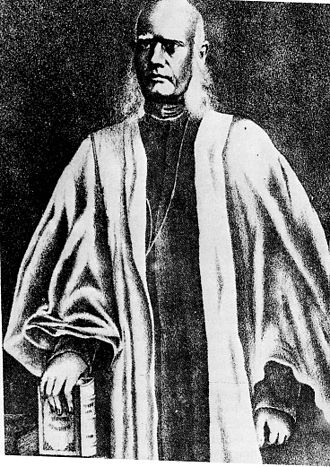
Figure: 1886 lithograph of Krishna Mohan Banerjee
Morality was being redefined for modern times by Young Bengal. The reformation they advocated in the personal lives of modern Indians became the norm over the next century as Indian leaders across the political spectrum adopted these principles of austerity against the wasteful expenditure of lavish marriages and worthless entertainments (a norm that has nowadays been breached once again in India by its wealthiest men).
Many minor and major transgressions were printed in the papers in these years, and some of the most extraordinary made their way into the history books to be repeated in every account of the scandal of Young Bengal. One well-known account was first mentioned in the Jñānānveṣaṇ in 1837, for instance, when it reported that ‘a young Hindoo who had received a liberal English education’, ‘[h]aving been forced to the shrine of Kalee he took off his cap, made a low bow to “Madam Kalee” and said he hoped her ladyship was well’. Instead of condemning such behaviour, the paper had commented: ‘An Indian boy, educated as they are, can no more believe in Kalee than we can ourselves.’
Another much-recounted scandal involving Young Bengal’s perceived disavowal of god and religion involved Rasik Krishna Mullick’s refusal to swear by the Hindu holy books in court. The Hurkaru had stated, apropos a forgery case in the Supreme Court: ‘On the oaths being administered to the jury respectively, one of them, Baboo Russick Krishna Mullick, editor of the Jñānānveṣaṇ, objected to all forms of swearing, saying, he understood none, and was of no religion.’ The Hurkaru did subsequently, in fact, print a letter from Rasik Krishna explaining his position more fully in their correspondence section, and also carried an editorial with extracts from his letter, where Rasik Krishna had laid down his moral reasoning clearly:
The baboo, in a letter to the Hurkaru, observes: ‘As I conceive the foregoing to be not only not a faithful report of what fell from me in the Supreme Court, but also calculated to cast a stigma upon my character, I beg to observe that I did not say I was of no religion; on the contrary, I distinctly stated to his lordship my firm conviction that I act in this world under a sacred responsibility to God, and I may here add, that I yield to none in the sincerity of my belief in one Supreme Being. As to my objecting to all forms of swearing, I have merely to remark, that as two only were proposed to me, I could not object to all of them. I however said that I did not understand the pundit; the reason of this is obvious: he repeated something in Sanscrit, of which language I know little or nothing. I have thought it necessary to say this much, in vindication of my character, because I consider that the observation above quoted might create an erroneous impression on the minds of the public with regard to my religious belief.
Rasik Krishna’s refusal to swear by the Hindu sacred texts had created an uproar, and this anecdote travelled across reports and history books in almost every account written of Young Bengal, while his response has remained lost in the archive till now. This was, of course, also a recourse to ‘Reason against Authority’, but cannot really be characterized as the sort of ‘advanced liberalism’ that Ranajit Guha, for one, found so full of ‘pathetic dignity’ in Dinabandhu Mitra, in relation to whom he declared, with the usual sweeping condescension of the Left historian, that in mid-nineteenth-century Bengal there could be no real liberals, ‘For Reason is born spastic in a colony.’ Yet as we see from the letter, Rasik Krishna’s refusal to take an oath in a language he did not understand shows him acting with the utmost conviction in Reason as well as morality, stating his ethical responsibility in the sober announcement that ‘I act in this world under a sacred responsibility to God’. There is a moving account of another young man wrestling with his moral and ethical responsibility at this time in the conservative Candrikā, which reported speaking to a contemporary of Rasik Krishna’s at the end of October 1831 after the Durga Puja festival was concluded:
We entertained doubts respecting what has been said in the Rutnakur about the school of Sharudaprusad Bose; because although he is a student of the Hindoo College, yet he is reckoned as one of the above royal family, (i.e. the family of Muharaj Kalee Kishun Bahadoor,) and therefore could by no means contemn or slight the Hindoo religion. Lately, however, we met Sharudaprusad. It was in the evening, at the time of throwing the idol of the royal house into the river when the name of Huree was shouted with the sound of cymbals, bells, and shells, &c. Sharudaprusad was then asked whether he regarded the divine image or not: and he readily and without fear replied that he did not. Silenced by this reply, we could no longer doubt respecting the statement of the Rutnakur. Moreover, Sharudaprusad being then reproved by Raja Kalee Krishun Bahadoor observed, ‘According to the writing which I have hitherto read, the idols and gods are certainly unworthy of regard; I now intend reading the Sungskrit shastras, and if I can thus learn that idols are worthy of regard, then I shall afterwards do what seems proper.’
The columnist ended with a rhetorical question addressed to Saradaprasad’s father, asking him to make sure to ascertain what conclusion he eventually came to on the matter, with a careful eye towards who ‘the offerer of the “jal pinda”’ [death ritual] for himself would be if his son still did not believe in idols or gods; for if so, his soul was destined to be ‘lost for ever’. Saradaprasad’s insistence here on an ethical course of action was based not on inherited normative structures of conduct but on his own capacity for moral discernment. This quality of honesty and straightforwardness in speaking publicly—‘readily and without fear’— was what marked Young Bengal’s responses to societal interrogation, accompanied by an insistence on a new moral order based on their own cognition, understanding and reading. Saradaprasad’s response is also significant for being an early example of not just an opposition to religion and ritual, but of an attempt to entertain the possibility that the chanting of ‘Huree’ and the immersion of ‘the divine image’ might constitute, on reinvestigation (‘I now intend reading the Sungskrit shastras’) a cultural, and even a secular, inheritance ‘worthy of regard’.
This excerpt has been carried from India’s First Radicals by the kind permission of Penguin Random House and you can buy the book by clicking on the book cover below.
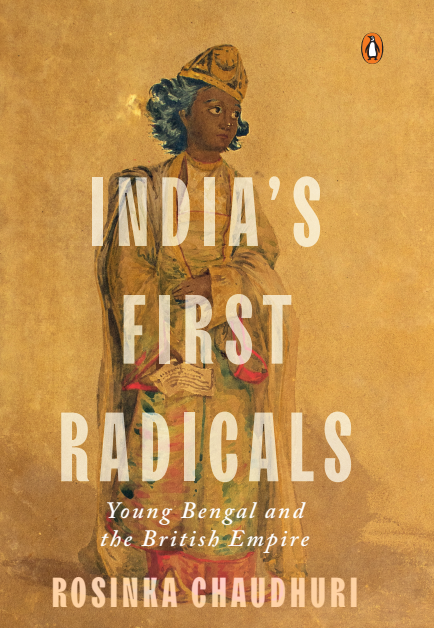
Rosinka Chaudhuri is director and professor of cultural studies at the Centre for Studies in Social Sciences, Calcutta. Her books include Gentlemen Poets in Colonial Bengal: Emergent Nationalism and the Orientalist Project (2002), Freedom and Beef Steaks: Colonial Calcutta Culture (2011) and The Literary Thing: History, Poetry and the Making of a Modern Cultural Sphere (2013). She has edited many books, among which are Derozio, Poet of India: The Definitive Edition (2008), A History of Indian Poetry in English (2016), and most recently, George Orwell’s Burmese Days for Oxford World’s Classics (2021). Many of her journal articles, reviews and book chapters have been published worldwide, while her translation of Rabindranath Tagore’s letters, titled Letters from a Young Poet (1887–1895), was published as a Penguin Modern Classic in 2014.




Leave a Reply