In 1950, India was a young nation finding its place in a world divided by the Cold War. Jawaharlal Nehru aspired that India should avoid alignment with either Washington or Moscow, and explore its own place in the Cold War world. His chosen envoy in Beijing was K. M. Panikkar, historian, intellectual, and one of the most unusual diplomats in Nehru’s circle, not least because the two often differed in their reading of international affairs.
Panikkar arrived in Beijing at a moment of extraordinary tension. The People’s Republic of China had been proclaimed only a year earlier, and the international order was shifting rapidly. Two crises unfolded almost simultaneously. In Korea, North Korean forces had crossed into the South, and UN troops under American command were pushing them back. Chinese leaders warned that if those troops advanced beyond the 38th parallel and approached the Yalu River, Beijing would intervene, seeing it as a direct threat to its own security. At the same time, Tibet, which had sought India’s help in preserving its autonomy, faced the prospect of invasion by the People’s Liberation Army. India’s embassy in Beijing stood at the crossroads of both these developments.
Panikkar’s task was to interpret Chinese intentions and communicate them to Delhi and to the Western powers. Zhou Enlai, China’s premier, assured him that Beijing had no immediate plans in Tibet, but warned with striking clarity that China would not tolerate UN forces on its frontier in Korea. Panikkar dutifully relayed these messages. Yet his reports were met with suspicion in Washington and London, where he was derisively nicknamed “Panicky Panikkar” and suspected of Communist sympathies. Within India, critics argued he had taken Chinese assurances on Tibet at face value, even as Western observers accused him of exaggerating Beijing’s threats in Korea.
Nehru, meanwhile, tried to walk a difficult line. He urged Tibetan leaders to settle for autonomy rather than risk outright conflict with China, even as he warned Western allies to take Chinese signals on Korea seriously. When China entered the Korean War in late October 1950, it confirmed the accuracy of Panikkar’s reports on that front. But in the same month, Chinese troops moved into Chamdo in eastern Tibet, exposing the limits of Zhou’s assurances and leaving India to grapple with the consequences of a new Chinese presence across the Himalayas.
The controversies around this period never really faded. Nehru’s China policy remains one of the most debated aspects of his leadership, and Panikkar’s role is still scrutinized. Was he an apologist for Beijing, or a realist who saw more clearly than others how China would act? Could India have handled Tibet differently? And how should we understand India’s own complex relationship with China in those years of shifting power? These questions linger, and they remind us how decisions made in those early years of independence shaped the decades that followed.
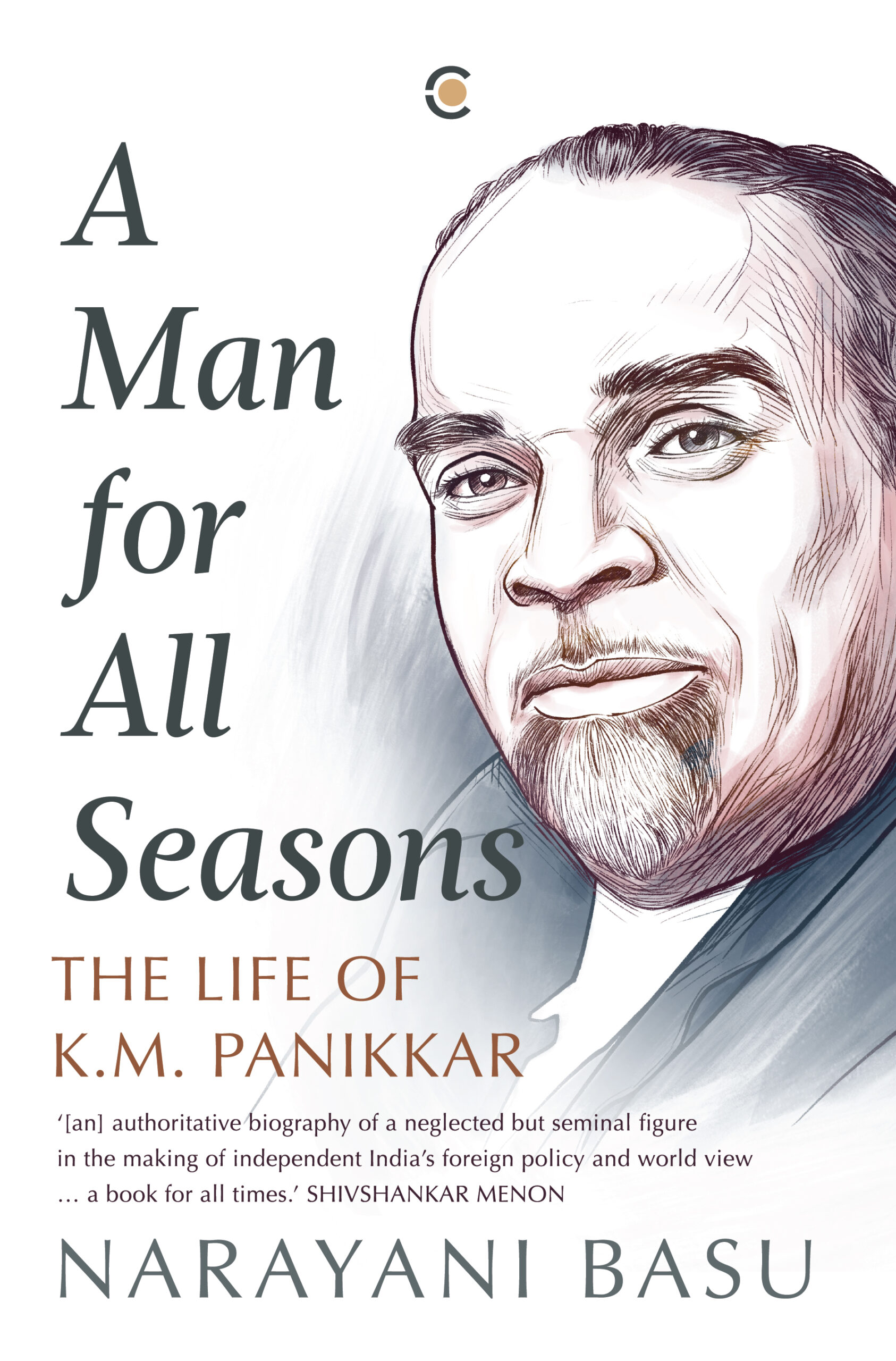
The excerpt we publish here from Narayani Basu’s A Man for All Seasons: The Life of K. M. Panikkar takes us into the heart of those critical months. It reveals the pressures on Panikkar in Beijing, the distrust he faced from Western diplomats, and the clash of crises in Korea and Tibet that tested India’s ability to navigate a divided world. Reading it today, we glimpse not only a fascinating figure in Indian diplomacy, but also the origins of dilemmas that remain with us still.
As New Delhi and Peking wrestled over Tibet, characteristically, Panikkar threw himself into writing his next book. The result of those labours, Asia and Western Dominance, would be published in 1953.
September edged into winter in Peking and Kaul noticed that the stress was beginning to tell on Panikkar. Gouri fell seriously ill that winter. Doctors diagnosed her with rheumatic fever, but her health remained tenuous at best throughout the end of 1950 and early 1951. She couldn’t breathe if she lay down, which meant she had to sleep sitting up. Rest eluded her and she was constantly plagued by fever. ‘Once or twice, we feared for her life,’ Panikkar remembered.
Caught between looking after Gouri and the constant tension that his work entailed, Panikkar was rarely in office. Kaul tried to persuade him to spend a little more time in the office, even going to the extent of changing the décor in the hopes of attracting the aesthete in the ambassador. But Panikkar stuck to his habit of coming in for not more than an hour a day. He told Kaul bluntly that he found most of the diplomatic representatives ‘rather dull’. His main points of contact among foreign legations were the British and the Swiss, while Kaul ran around networking with the Soviets, the Burmese and the others. Having a deputy in Peking was some relief for Panikkar, who took to calling Kaul over every evening for a cup of tea or a drink. Over drinks and snacks, the two men would chat about home, the Cold War, America, the Soviets and China. ‘He would tell me, with a twinkle in his eye, about how he had hoodwinked some of the Western representatives,’ Kaul remembered. ‘They used to flock to him every time he met Chou En-lai or other Chinese leaders to get some crumbs of information to send to their Foreign Offices. Panikkar took an almost mischievous delight in sending them off the trail.
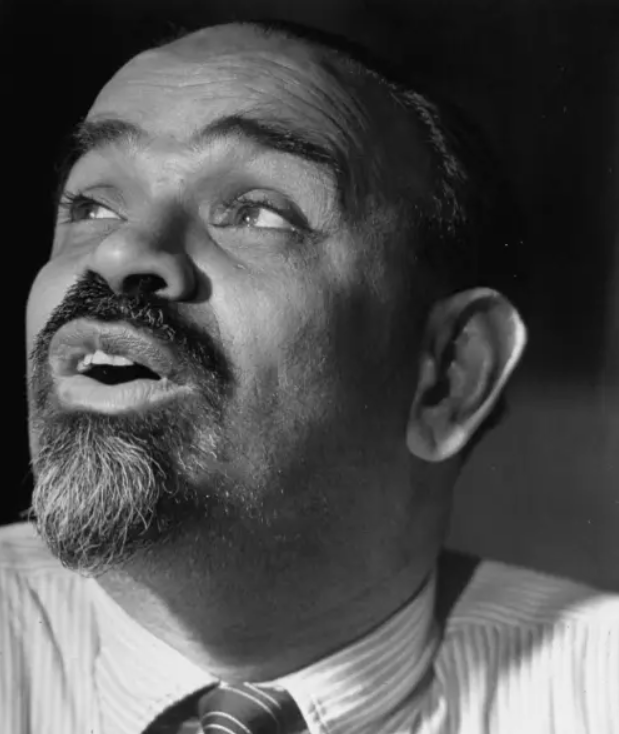
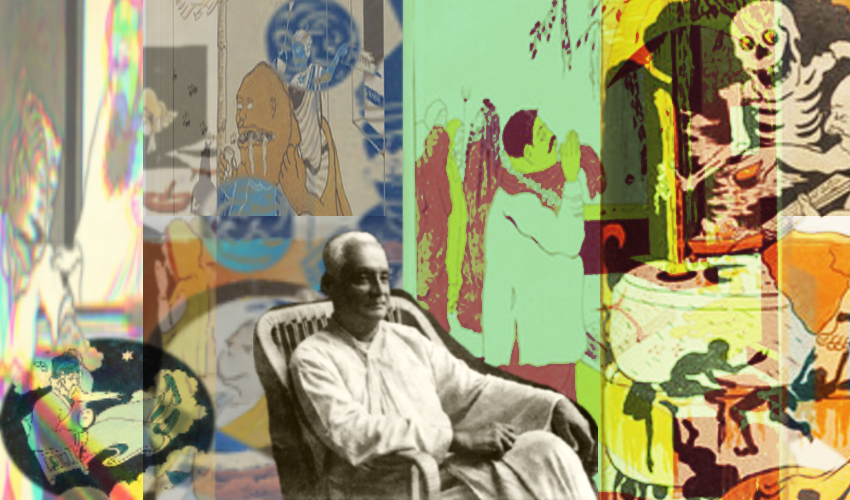
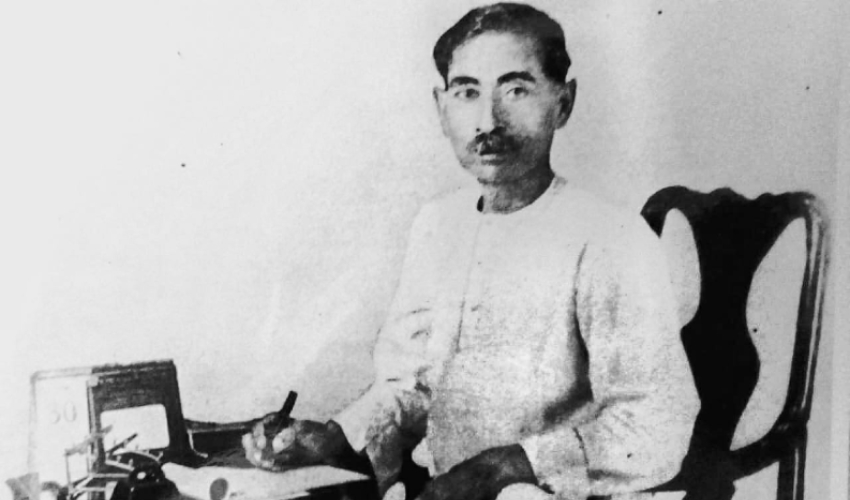
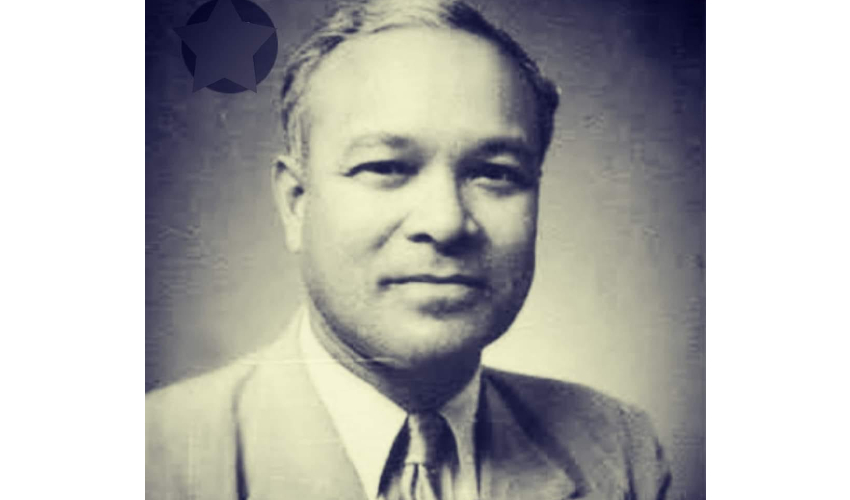
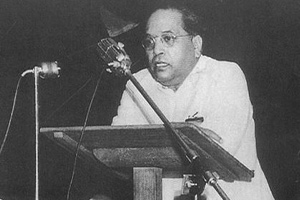
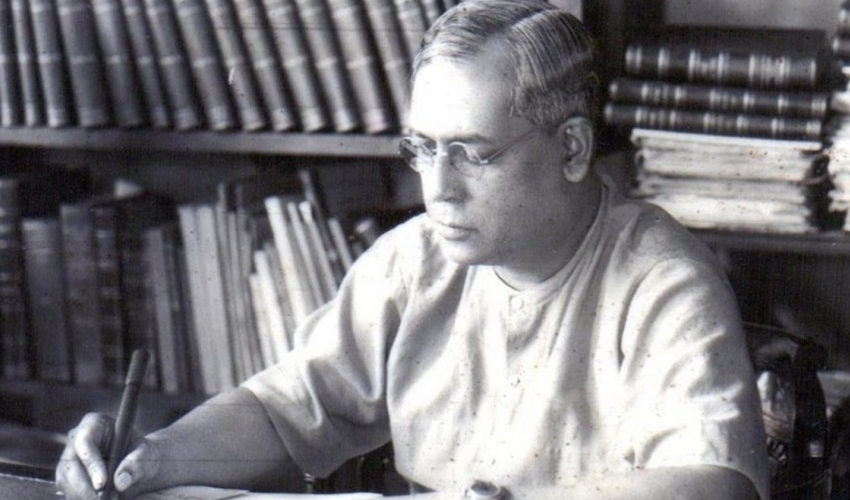
Figure: K. M. Panikkar
This was being a little too honest for Kaul, who was slightly alarmed. He remonstrated with Panikkar, suggesting that perhaps he should not mislead his colleagues. But to his consternation, Panikkar merely laughed, waving them away as a ‘bunch of fools’, and adding that ‘he had utter contempt for them’.
Dismayed as he was by this sort of behaviour, Kaul couldn’t help admitting that working with a man so intelligent was a delight. ‘He and I worked as a team, and kept no secrets from each other.” If they differed in their theoretical and academic analyses, Panikkar would goad Kaul into reciting the different manifestos to find out where exactly they differed. Kaul didn’t mind in the least. Working with Panikkar, he found, was a bit like working with a rather eccentric but brilliant professor.
In between work, Panikkar would take Kaul around Peking, sometimes by themselves and sometimes with Devaki and her best friend from England, a Chinese girl named Christine. The two girls were often away, travelling across China themselves. For Devaki, being in communist China was a delight. To her own travels, she brought her unique sense of history and politics and the fluent Russian she had learned in England. She also seriously alarmed China-watchers in Delhi, the United Kingdom and the United States by indulging in a little pro-communist journalism of her own. In an article she published in the Indian Daily Mail in March 1951, Devaki defended the PRC’s alliance with the Soviet Union. ‘Naturally China prefers help from a country which treats her as an equal and is a friend rather than from countries which will take every opportunity to disrupt the new regime. She railed against the devious methods of the United States and the propaganda spread by ‘a capitalist press, including our own’.
Unsurprisingly, this article was enough to have Devaki put immediately under surveillance by an aghast CIA. A daughter so openly communist could hardly have been beneficial to a beleaguered Panikkar, but he refused to see how his daughter’s ideologies were anyone else’s business but her own.
A historian himself, Panikkar was acutely aware of the depthless history that China possessed. The Old City of Peking remained his favourite. Kaul would remember it as the centre that held the balance between north and south China, just a few hours away from the Great Wall and the famous Ming Tombs. Panikkar showed him around the Temple of Heaven, the Nine Dragon Pagoda, the Forbidden City and Tiananmen Square. On long holidays, they would go off to Peita Ho near the sea, where a cottage could be rented. Panikkar, who loved his food, introduced his deputy to Peking’s narrowest and most winding streets, most of which ironically housed the city’s best restaurants, where Kaul was revolted by the ambassador’s delight in frog’s legs, monkey’s brain and python’s heart. On weekends, Panikkar took Kaul to discover Peking’s many beautiful museums, or shopping for Ming porcelain, silks or the famous Tang dynasty horses. The Indian ambassador, his deputy discovered, was a great connoisseur of the arts. He enjoyed the opera both for its dramatic opulence and for its effectiveness in conveying propagandist messages.
The two men talked wistfully of India sometimes, and Panikkar remembered the old days and how things had changed with partition. ‘He delighted in running down people whom he called ‘Somnathists’ or revivalists, who wanted to rebuild old temples desecrated by some of the Muslim invaders,’ Kaul remembered. ‘He was vehemently secular in his outlook and non-religious with a vengeance.’ Neither Panikkar nor Kaul had the time to travel out of Peking in 1950, since geopolitics dominated much of their time. But in the capital alone, it was clear that there was a new energy, ‘an evangelical atmosphere everywhere and complete faith in Mao’s leadership’.
But there were differences that both Indians noticed. There was, for instance, no individual privacy. Everyone was a member of a group and led a group life. Nationwide movements against corruption were launched with merciless efficiency and no compassion was shown to anyone considered to be an enemy. Foreigners were suspected. Contact with them was forbidden, a fact that made it hard to build a network among people who were not authorised government officials.
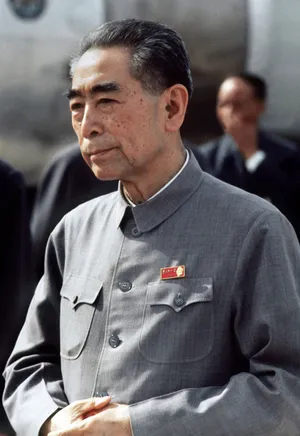
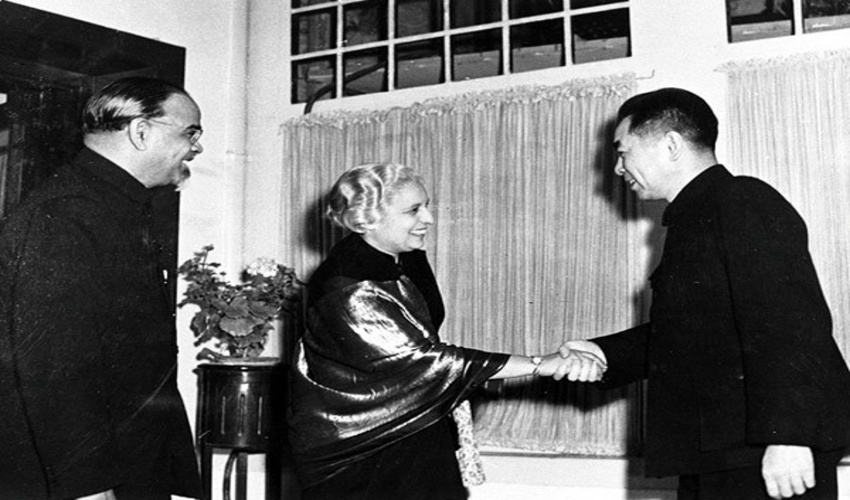
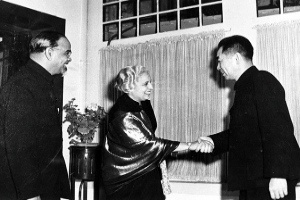
Figure: Zhou Enlai
On 3. September 1950, Panikkar had Zhou over for dinner. The Chinese premier, in a gesture of friendly attention (which the Chinese had become remarkably adept at) brought his wife with him. The main subjects for discussion were China’s apprehensions conversation with Zhou over dinner, Panikkar told Delhi what China regarding Formosa and the bombing of Manchuria. Reporting on his conversation with Zhou over dinner, Panikkar told Delhi what China was worried about was actually Xinjiang. Peking had no intentions of ‘taking immediate military action against Tibet itself’.
Whether Nehru believed this or not at this juncture is something we will never know, but three days later, on 6 September, the prime minister met the defeated Shakabpa and warned him that ‘Indian diplomatic support was available only for autonomy. The alternative was Chinese invasion. Tibetans must make a choice between war and peaceful settlement.’
Neither man was truly transparent in this conversation.
Nehru didn’t tell Shakabpa that he wasn’t sure if Tibet would really enjoy the same ‘autonomy’ as before. Shakabpa on his part didn’t tell Nehru that he was continuing talks with the Americans or that he had been promised aid to resist Chinese occupation.
Across the Himalayas, China was running out of patience as the months edged towards winter. There was now a growing belief that UN forces would cross the 38th parallel into the north. Peking was worried about the Yalu River being crossed in the aftermath of the Battle of Inchon. On 21 September, Zhou met Panikkar and told him bluntly that since ‘the UN claimed to have no obligations towardsChina, she also had none to the UN’.
Panikkar was severely taken aback at this outspoken statement of Chinese policy. This meant that, if the US-led UN forces were to cross the 38th parallel, China would fight. He confirmed this suspicion a few days later in a chat with the Chinese acting chief of staff Nie Rongzhen, who frankly said that China was bent on a more aggressive policy. It no longer cared about consequences. These points formed the basis for Panikkar’s report to Delhi in which he said that India was no longer in a position to offer counsel to China without being misconstrued. China was unlikely to directly involve itself in Korea unless a world war broke out with the UN forces crossing the 38th Parallel. Horrified at Panikkar’s report, Nehru wrote immediately to Zhou, praising Chinese restraint under the circumstances.
Zhou did not deign to reply.
Instead, in his official report to the National Committee, the Chinese premier explicitly stated what China intended to do: ‘The Instead, in his official report to the National Committee, the Chinese people absolutely will not tolerate foreign aggressor nor will they SPINELY tolerate seeing their neighbour being SAVAGELY invaded by imperialists … There is no doubt that China views international situation as menacing her security and independence and will fight if American forces try to occupy Korean territory.
On 3 October 1950, Panikkar was awakened at midnight, and his steward nervously told him that Chen Jiakang, the director general of Asian Affairs in the PRC foreign ministry, wished to speak with him downstairs. Bundling himself hastily into his dressing gown, Panikkar hurried downstairs to the drawing room. Chen told him courteously that Zhou En-lai wanted to see him immediately.21 At Zhou’s residence half an hour later, the table was set for tea for two. Zhou, Panikkar recalled later, was ‘as courteous and charming as ever’, and while he apologised for awakening the Indian ambassador at this mean hour of the night, he simply stated that ‘if the Americans cross the 38th parallel, China will be forced to intervene in Korea’.22 His demeanour gave no sign of worry, nerves or agitation, and he smiled as he offered Panikkar a second cup of tea.
Panikkar rushed back to the embassy and cabled New Delhi at half past one in the morning. The next day, Nehru lost no time in letting Truman and Attlee know what was happening.
With the second largest contingent in Korea, Britain was alarmed Provoking China in Korea could also lead to an attack on Hong Kong. The stakes were high for London. The British Joint Chiefs of Staff were led by the commander of the British forces in India and Burma during the Second World War, Field Marshal Sir William Slim, who knew a great deal about China. Slim had been worried since July that moving north of the 38th parallel would provoke Chinese intervention. When Panikkar’s message arrived in London, the Joint Intelligence Committee (JIC), which prepared synthesised it reinforced his fears. But the British intelligence community, led by estimates for the British prime minister, was more cautious. It dismissed Zhou’s warning as not being specific enough.
For his part, Truman was not convinced. Even though the head of the China desk at the state department emphasised that this was unlikely to be a bluff, the US president didn’t trust the Indian ambassador at all. ‘The problem that arose in connection with these reports was that Mr. Panikkar had in the past played the game of the Chinese Communists fairly regularly, so that his statement could be taken as that of an impartial observer, he would write in his memoirs. ‘It might very well be no more than a relay of Communist propaganda.
It speaks volumes about how deep the distrust of Panikkar was already running that an American president felt this way and was unafraid to say so. Indeed, the American establishment at this time, whether it was diplomatic or CIA, unanimously suspected Panikkar of communist tendencies and of being singularly untrustworthy.24 Dean Acheson, for instance, cuttingly dismissed Panikkar’s warning as the ‘mere vapourings of a Panicky Panikkar’.25 Walter McConaughy, the former US consul general in Shanghai, was asked for his opinion of the situation on the ground. He replied that not only was Panikkar a ‘man without integrity of character and without deep moral convictions’, but that McConaughy was convinced-though on what basis remains unclear that Panikkar was so consumed with anti-colonial sentiment that he had developed an aversion to the Western world. As a result, he was heavily leaning towards China and any dispatch he sent from Peking must be ‘taken with a large grain of salt’. As he rather nastily put it, ‘Panikkar’s Mephistophelian quality is not limited to his spade beard.
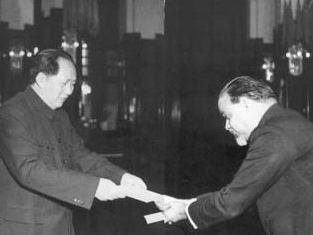
Figure: Mao Zedong with K. M. Panikkar
When he heard that the United States had refused to take his reports seriously, Panikkar was deeply upset. In his diary, he wrote, ‘America has knowingly elected for war, with Britain following. The Chinese armies now concentrated on the Yalu will intervene decisively in the fight. Probably some of the Americans want that. They probably feel that this is an opportunity to have a show down with China. In any case MacArthur’s dream has come true. I only hope it does not turn into a nightmare.
It is a sad, frustrated entry, which is how Panikkar felt those days. The divisions in opinion about him were not a secret. In a telegram, the Indian prime minister had tried to comfort him. ‘All this, of course, does not affect our policy in the slightest. It only confirms it. and shows the immaturity of American judgement … I’m supposed to have ‘sold out’ to Mao through your bad influence. Panikkar is referred to as ‘Panicky’. It really is amazing how great nations are governed by very small people.’
But Panikkar was beyond comfort at this point. He was never a very expressive man, nor was he given to public displays of emotion, but for his loyalty to his country to be thus called into question was too much for him. His refuge now was to wrap himself in a cloak of cold hauteur. It did nothing to endear him to colleagues who were already suspicious of him-and the events of that winter only proved to Panikkar’s critics that the Indian prime minister was being guided by an ambassador who was telling him what he wanted to hear, and more damagingly, seemingly did not know how to read the events on the ground.
On 7 October, 9,000 seasoned PLA troops crossed the Yangtse River into Tibet. They were met by a terrified, poorly trained force of 4,000 Tibetan soldiers who were rapidly overwhelmed. By 11 October, the People’s Liberation Army was nearing Chamdo, a large town in eastern Tibet, on the way to Lhasa. The regional governor tried frantically to contact his capital to let them know what was coming but there was no response. Four days later, in the midst of chaos, Lhasa finally replied.
‘Right now it is the period of the Kashags’ picnic and they are all participating in this,’ the horrified governor was airily told. ‘Your telegrams are being decoded and then we’ll send you a reply.’
Incensed, the governor hung up on the call, but not before he had been betrayed into shrieking, ‘Shit the picnic!’
This excerpt has been carried from A Man for All Seasons: The Life of K. M. Panikkar by the kind permission of Westland Books and you can buy the book by clicking on the book cover below.





Leave a Reply